
Menu
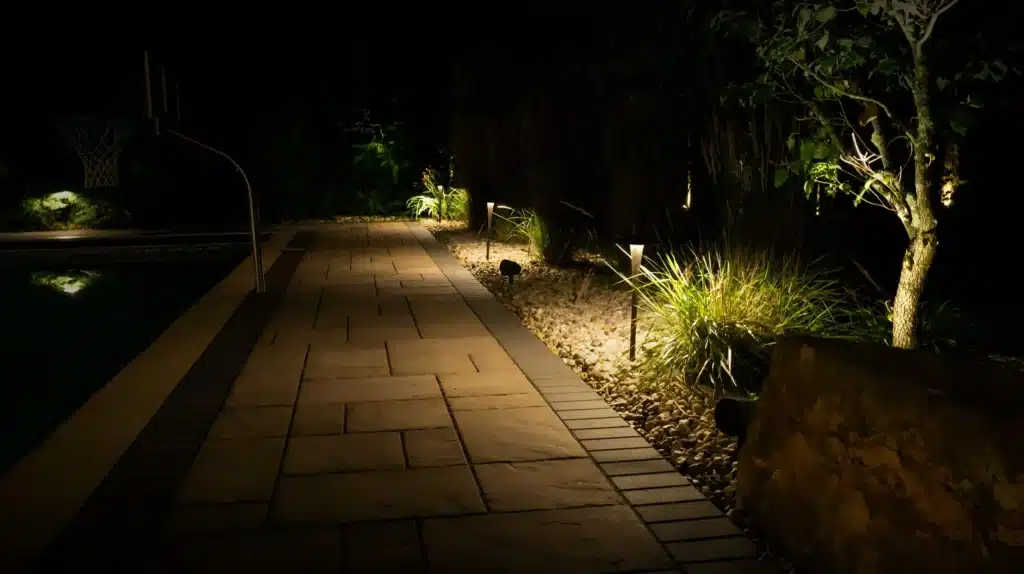
How to light your walkways, garden paths, and driveways for safety, beauty, and year-round curb appeal in the Indianapolis climate.
Of all the outdoor lighting choices you can make, pathway and driveway lighting delivers the most everyday value. Every single time you or a guest arrives home after dark, walks to the front door, or navigates the driveway, this lighting is quietly doing its job — guiding footsteps, preventing stumbles, and rolling out a welcoming glow.
For Indiana homes, that job is even more important than in milder regions. Our winters bring ice, our summers bring lush overgrowth, and our long driveways and winding garden paths can turn treacherous in the dark. A thoughtfully designed pathway and driveway lighting system solves all of that while dramatically elevating your home's nighttime curb appeal.
With the height of summer here in July, your landscaping is at its fullest and your outdoor living season is in full swing — making right now an ideal moment to evaluate how well your paths and drive are lit, and to plan improvements before the early sunsets of fall return. This guide covers the ideas, techniques, and local considerations that make pathway and driveway lighting work beautifully for Indiana homes.
Safety is the headline benefit. Indianapolis winters coat walkways and drives in ice and packed snow, and a poorly lit path becomes a genuine slip-and-fall hazard for family, guests, and delivery workers. Even in summer, uneven pavers, garden steps, and transitions between surfaces are far safer when clearly illuminated.
Beyond safety, this lighting shapes the entire first impression of your home. A well-lit path draws the eye toward your entrance and creates a sense of arrival and welcome, while a dark, unlit walk feels uninviting and even unsafe. There's a security dimension too: illuminated approaches eliminate the shadowy hiding spots near entries that intruders prefer, and a home that's clearly lit signals that someone is paying attention.
Finally, there's pure beauty. The gentle rhythm of light along a garden path, the soft wash across a paver driveway, and the glow spilling onto surrounding plantings turn a functional route into a designed experience.
The most familiar approach is the classic path light — a fixture on a stem with a shielded top that casts a soft pool of light downward onto the walkway. The key to doing this well is restraint and spacing. Homeowners often make the mistake of lining a path with evenly spaced fixtures every few feet, creating an "airport runway" effect that looks artificial and harsh. Instead, professionals stagger fixtures and space them to let pools of light overlap gently, leaving natural transitions of shadow between them. This creates a more organic, high-end look while still lighting the entire path.
Downlighting offers a more subtle alternative. By mounting fixtures in nearby trees or on architectural elements and aiming them down at the path, you achieve a natural, moonlit effect that illuminates the walkway without any visible fixtures at ground level. This works beautifully where mature trees line a path and creates gorgeous dappled shadows.
For steps and grade changes — which are common on Indiana's rolling lots — recessed step lights or low fixtures at each transition prevent missteps and add a refined architectural touch. Garden paths that wind through planting beds benefit from fixtures tucked among the foliage, lighting both the path and the plants for a layered, immersive effect.
Indiana properties often feature long or curved driveways, and lighting them well is both a safety and a design opportunity. The most popular approach is a series of low bollard or path-style fixtures running along one or both edges of the drive, defining its boundaries so drivers can clearly see the edges even under a dusting of snow. Along a curved driveway, these fixtures are especially valuable for tracing the turn.
For a cleaner, more subtle look, downlighting from trees or from fixtures mounted on the home or garage can wash the driveway surface with soft light and no visible ground fixtures. Many homeowners also highlight the entrance to the driveway with a pair of column-mounted or pillar lights, marking the transition from street to property with a welcoming, estate-like presence.
Where a driveway meets a garage or motor court, adding illumination to the surrounding landscaping and any nearby architectural features ties the whole scene together, so the drive doesn't feel like a dark void beside a beautifully lit home. Motion-activated fixtures near the garage add convenience and security, lighting up automatically as you pull in.
The best pathway and driveway lighting designs treat these routes as part of a unified whole rather than isolated strips of light. As light guides you from the street, up the drive, and along the path to the door, it should feel like a continuous, intentional journey. Coordinating color temperature across all fixtures — warm white in the 2700K to 3000K range is ideal for Indiana homes — keeps the scene cohesive and inviting.
Layering matters too. Pairing low path and driveway fixtures with uplighting on nearby trees, grazing on adjacent stone or brick, and a well-lit entryway creates depth and dimension, so the path lighting feels integrated into a complete landscape design rather than tacked on. This layered approach is what separates a professional installation from a DIY string of identical fixtures.
Everything covered in our winter lighting guidance applies doubly to pathway and driveway fixtures, because these sit low to the ground where they endure the most abuse. They're closest to snow removal, most exposed to road and sidewalk salt, and most vulnerable to being clipped by a shovel, plow, or snowblower.
For this reason, solid brass and copper fixtures are strongly recommended. They withstand Indiana's freeze-thaw cycles without cracking, resist corrosion from salt, and shrug off the occasional bump far better than brittle aluminum or plastic. Pair them with cold-rated LEDs and waterproof, direct-burial-rated connections, and the system will perform reliably for years. It's also wise to place fixtures a bit back from the very edge of drives and walks, out of the direct path of snow-clearing equipment, while still lighting the surface effectively.
The runway effect is the most frequent error — too many identical fixtures spaced too evenly, producing a harsh, artificial line of light. A more natural, staggered layout with overlapping pools of light always looks better. Over-lighting is another common misstep; pathway lighting should be a gentle guide, not a floodlit spectacle, and softer light actually reads as more elegant and inviting.
Choosing cheap fixtures is a costly mistake in our climate, as budget aluminum and plastic units fail quickly under Indiana winters and salt exposure. Ignoring color temperature consistency — mixing warm and cool bulbs — creates a disjointed look, and forgetting about glare, where an unshielded fixture shines into the eyes rather than onto the path, undermines both beauty and safety. A professional design avoids all of these by planning fixture placement, shielding, spacing, and output as a coordinated whole.
How far apart should path lights be spaced? There's no rigid rule, but a natural, staggered spacing that lets pools of light gently overlap looks far better than evenly spaced fixtures every few feet. A professional will space them based on your path's length, curves, and the fixture's output rather than a fixed measurement.
Are solar path lights a good option in Indiana? Solar lights are inexpensive but generally underperform in our climate, especially through cloudy Indiana winters with short daylight hours and snow-covered panels. Low-voltage LED systems provide consistent, reliable brightness year-round and last far longer.
Can pathway lighting help with winter safety? Absolutely. Illuminating walkways and driveways is one of the best ways to prevent slips and falls on ice and snow, making it both a safety and a curb-appeal investment.
How much does driveway and pathway lighting cost in Indianapolis? Cost depends on the length of your paths and drive, the number of fixtures, and the quality of materials. A focused pathway and driveway package typically falls within the starter-to-mid range of a full landscape lighting system, and a professional can provide a detailed quote after assessing your property.
Should driveway lights be on both sides? Not necessarily. Many attractive designs light only one side, or use downlighting from trees, to avoid the runway look. The right approach depends on your driveway's width, shape, and surroundings.
Your pathways and driveway are the routes you and your guests travel most, and lighting them well pays off every single evening — in safety, in beauty, and in the warm sense of welcome your home projects to the street. With summer in full swing, now is the perfect time to design a system that will guide you safely and beautifully through the darker months ahead.
Lite Outdoor designs custom pathway and driveway lighting for Indianapolis and the surrounding communities, using premium brass and copper fixtures, cold-rated LEDs, and thoughtful, layered design that avoids the runway look and delivers genuine curb appeal. We build systems engineered to shine through every Indiana season.
👉 Schedule your free consultation and nighttime demonstration today at LiteOutdoor.com
Explore more in this series: start with our pillar guide, Outdoor Lighting Indianapolis: The Complete 2026 Guide, and continue with Best Landscape Lighting for Indianapolis Winters and Uplighting vs. Downlighting vs. Moonlighting.
