
Menu
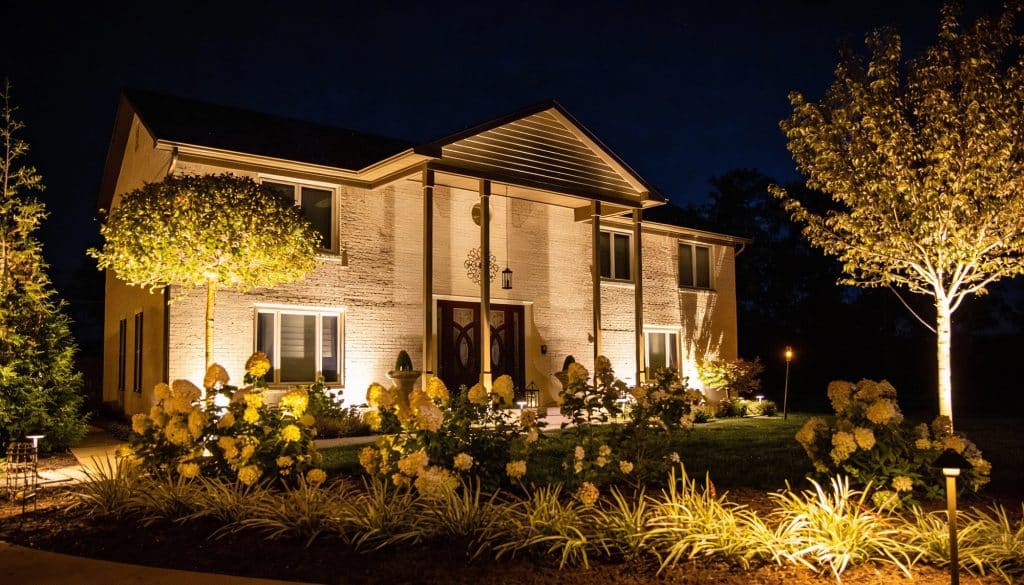
Understanding the two types of outdoor lighting systems — and why low-voltage is the right choice for most Indianapolis landscapes.
Before a single fixture goes in the ground, every outdoor lighting project starts with a foundational choice: low-voltage or line-voltage? It's a decision that shapes your system's safety, efficiency, flexibility, cost, and how easily it can be adjusted or expanded down the road.
For most Indianapolis homeowners, the answer is clear, but understanding why helps you have an informed conversation with your lighting professional and feel confident in your investment. This guide breaks down both systems in plain language, explains the pros and cons of each, and clarifies which situations call for which approach in the Indiana climate.
Low-voltage landscape lighting operates at 12 volts rather than the 120 volts running through your home's standard outlets. A device called a transformer steps that household 120V power down to a safe 12V, which then powers the fixtures through buried low-voltage cable.
This is the standard for modern residential landscape lighting, and it's what the vast majority of professional installations use today. The low operating voltage makes the entire system dramatically safer to install, live with, and maintain, while modern LED technology means these systems produce plenty of beautiful, bright light despite the lower voltage.
Line-voltage lighting, sometimes called high-voltage or 120V lighting, runs directly on your home's standard household current with no transformer stepping the power down. Because it carries full household voltage, it's more powerful and is typically used for applications that demand high output over large areas.
In residential settings, line-voltage is most often reserved for large security floodlights, tall pole-mounted area lights, and certain permanent architectural fixtures. Because of the higher voltage, these systems require deeper wire burial, conduit, and installation by a licensed electrician following stricter code requirements.
For landscape and accent lighting, low-voltage systems offer a compelling list of advantages that explain their dominance in modern design.
Safety is the headline benefit. At just 12 volts, the risk of dangerous electrical shock is minimal, which makes the system far safer around children, pets, gardening activities, and the moisture-rich environment of an Indiana landscape. This lower risk profile also means the cable doesn't require the deep burial and conduit that line-voltage demands, simplifying installation.
Flexibility is another major advantage, and it's one homeowners appreciate for years. Low-voltage fixtures are relatively easy to relocate, add to, or adjust as your landscape matures and your needs change. As trees grow, gardens fill in, or you decide to highlight a new feature, a low-voltage system adapts without major reconstruction — a real benefit given how much Indiana landscapes change across seasons and years.
Energy efficiency rounds out the case. Paired with modern LEDs, low-voltage systems sip electricity, keeping your operating costs minimal even when your lights run for the long hours of an Indiana winter evening. And because these systems are the industry standard for landscape work, you'll find the widest selection of quality brass and copper fixtures designed specifically for low-voltage use.
Line-voltage isn't wrong — it's simply suited to different jobs. Its higher power output makes it the right choice for large security floodlights that need to blanket a wide area with bright light, for tall pole lights illuminating expansive driveways or parking areas, and for certain permanent, high-output architectural applications.
Many Indianapolis properties actually end up with a hybrid approach: a low-voltage system for the artistic landscape and accent lighting that defines curb appeal, combined with a few line-voltage fixtures where high-output security lighting is genuinely needed. A skilled professional designs the right blend for your specific property and goals.
When it comes to the artistry of landscape lighting — uplighting trees, moonlighting patios, grazing stone, and lining pathways — low-voltage is almost always the superior choice. The lower voltage gives designers finer control over light placement and intensity, the fixtures are more discreet and easier to conceal, and the flexibility to fine-tune the system after installation means your lighting can be perfected over time.
In the Indiana climate specifically, the ability to easily access, adjust, and reseal low-voltage connections is a practical advantage, since our freeze-thaw cycles and ground heave occasionally shift fixtures that then need realignment. A low-voltage system makes that ongoing care far simpler than a line-voltage one.
Is low-voltage lighting bright enough? Absolutely. Modern low-voltage LED fixtures produce ample, beautiful light for every landscape lighting application, from subtle accent lighting to dramatic uplighting on large trees. The lower voltage refers to the electrical system, not the brightness of the light.
Is low-voltage lighting safe around children and pets? Yes, that's one of its biggest advantages. At 12 volts, the shock risk is minimal, making it far safer than line-voltage in the moisture-rich, active environment of a family landscape.
Can I install low-voltage lighting myself? While low-voltage is safer than line-voltage, a professional installation ensures proper transformer sizing, waterproof direct-burial connections, correct fixture placement, and a design that avoids glare — details that matter enormously for both performance and longevity in the Indiana climate.
Do I need an electrician for low-voltage lighting? The low-voltage portion doesn't require the same licensed-electrician code requirements as line-voltage, though the transformer must be connected to a proper power source. Reputable lighting companies handle all of this correctly and pull any permits required for the line-voltage connection.
Can I mix low-voltage and line-voltage on my property? Yes, and many homes do. A common approach uses low-voltage for artistic landscape and accent lighting and line-voltage for high-output security floods where needed. A professional designs the right combination for your property.
The low-voltage versus line-voltage decision sets the foundation for everything your outdoor lighting system will become. For the beauty, safety, flexibility, and efficiency that Indianapolis homeowners want from landscape and accent lighting, low-voltage is almost always the right answer — with line-voltage reserved for the specific high-output jobs where it excels.
Lite Outdoor designs and installs premium low-voltage landscape lighting systems for homes throughout Indianapolis and the surrounding communities, integrating line-voltage security lighting where it makes sense. We'll recommend the right approach for your property and handle every technical detail with care.
👉 Schedule your free consultation and nighttime demonstration today at LiteOutdoor.com
Explore more in this series: start with our pillar guide, Outdoor Lighting Indianapolis: The Complete 2026 Guide, and continue with Best Landscape Lighting for Indianapolis Winters and How to Choose an Outdoor Lighting Company in Indianapolis.
