
Menu
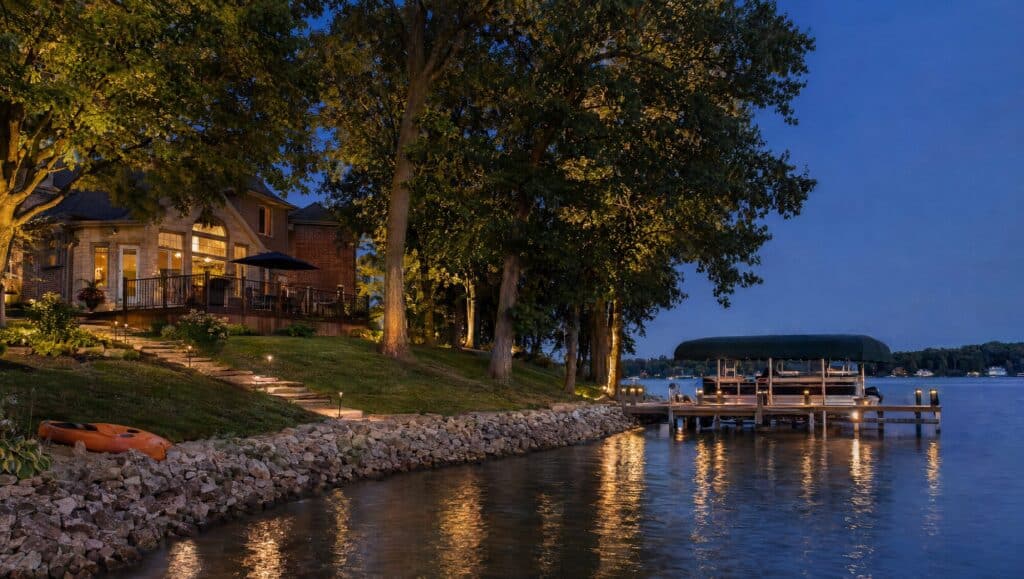
Water changes everything about outdoor lighting. Here's how Geist homeowners can light a dock, a seawall and a lakeside patio so it looks good from the house, from a boat and from across the cove.
If you live on Geist, you already know the best part of an August evening is the hour after sunset. The boats thin out, the water goes flat, and everybody drifts down to the dock with a drink. The trouble is that most lakefront yards go from "golden hour" to "where are the steps?" in about fifteen minutes.
Lighting a waterfront property isn't the same job as lighting a front yard in Carmel or a backyard in Westfield. The lake acts like a giant mirror. A light that looks soft and pleasant on land can throw a hard streak of glare across the water that your neighbors see from their deck a few hundred feet away. Get it right, though, and a Geist home at night is about as good as outdoor lighting in Indianapolis gets.
Here's what we think about when we design lighting for a lakefront lot.
Most Geist lots slope toward the shoreline, and a lot of them have a mix of stone steps, landscape timbers and paver landings on the way down. That walk is where people actually get hurt, so it comes first. It's the same thinking behind our pathway, walkway and driveway lighting, just on a steeper grade.
We like low path lights or small step lights tucked into the risers, spaced so each landing and each change in grade has its own pool of light. You don't need the whole hillside bright. You need every place a foot lands to be clear. A few well placed fixtures beat a row of bright ones every time, and they keep the slope from looking like an airport runway when you look back up at the house from the dock.
If you have a mature oak or maple near the path, moonlighting from up in the canopy is worth considering. A fixture mounted high in the tree and aimed down gives you soft, dappled light on the ground with no visible source, which is the look most lakefront owners are after anyway. We cover the different aiming techniques on our moonlighting and special effect lighting page, and in our guide to uplighting, downlighting and moonlighting.
The most common mistake we see on the water is a single bright floodlight mounted on a boat lift or a post at the end of the dock. It lights the dock, sure. It also blinds anyone walking toward it, lights up the bottom of every bug's wings for half a mile, and puts a glaring hotspot in the view from every house across the cove.
A better approach is to keep dock light low and pointed at the deck boards:
That combination gives you a clear, safe walking path and an easy-to-spot outline for anyone pulling in by boat, without turning the end of your dock into a beacon. If you also have a pool or a garden pond up by the house, our pond and pool area lighting follows the same low-glare approach.
Color temperature matters more by the water than anywhere else on the property. Cool white light in the 4000K to 5000K range reflects harshly off the lake, attracts more insects and tends to look clinical next to wood docks and natural stone.
For lakefront work we usually stay around 2700K, and sometimes warmer along the shoreline itself. Lighting guidance written with wildlife in mind leans even warmer. The U.S. Fish and Wildlife Service, for example, recommends amber light at or below 2200K for structures near water. You don't have to go that far everywhere, but keeping the whole system warm and consistent is what makes it look intentional instead of patched together.
Here's a habit we recommend to every lakefront client: next time you're out in the boat after dark, look back at your own house. It's eye-opening. Most people have never seen their property from the water at night, and a fixture that seems harmless from the patio can be the brightest thing on the shoreline.
Light travels a long way across open water. The Wisconsin DNR's guide to shoreland lighting makes this point well. Glare is the most common lighting problem on a lake, and it's also one of the easiest to fix. In practice that means:
Your neighbors will thank you, and honestly your own view of the lake will be better for it. It's hard to enjoy the water at night when your own lights are bouncing off it.
On a lot of Geist properties, the lake side of the house is really the front. It's the side boaters see, it's usually where the big windows and decks are, and it's where you spend your evenings.
Soft grazing on stone or siding, a couple of lights on the columns under an elevated deck, and gentle uplighting on one or two signature trees go a long way. The goal is a house that reads as warm and lived-in from the water, with the shoreline trees framing it. If you want ideas for the architecture itself, our architectural lighting page walks through how we light stone, columns and rooflines.
Lakeside patios tend to get used late. That's the whole point of them. For these spaces we layer a few things: small lights under the cap of seat walls, a couple of downlights from a pergola or nearby tree over the dining area, and task lighting at the grill. The fire pit takes care of itself.
Putting the patio on its own zone also helps. You can have it bright enough for dinner, then dim it down when you want to watch the water or the stars. Our deck and patio lighting page has more on how we approach these spaces.
Water and electricity need to be handled carefully, and this is where a waterfront project differs most from a standard yard.
Use low-voltage lighting wherever you can. A professional 12-volt landscape system with the transformer mounted on land, well above any flood line, is the safest and most practical way to light paths, trees and most dock edges. We explain why in low-voltage vs. line-voltage landscape lighting.
Anything powered on the dock itself falls under special rules. Since the 2017 edition, Article 555 of the National Electrical Code has applied to residential docks as well as marinas. It covers things like ground-fault protection, keeping connections up out of the splash zone, and warning signs about shock hazards in the water. If you have receptacles, a boat lift or line-voltage lights on your dock, have a licensed electrician check them. Electric shock drowning is rare, but it's the reason these rules exist.
Check with Citizens Energy before you build near the shoreline. Citizens Energy Group owns the reservoir and a 20-foot easement along the shoreline, and docks, seawalls, walkways and patios in that zone need their approval. Simple low-voltage lighting on an existing dock usually isn't a big deal, but if your lighting plan is part of a new dock, a seawall project or a patio near the water, sort out the permit first. It's much easier than redoing work later.
An astronomical timer or a smart controller adjusts to sunset automatically, so the lights come on at dusk in June and in December without you touching anything. We usually set lakefront systems up with at least two zones: the path and dock lights for safety, and the "show" lighting on the house and trees. A common setup is everything on at dusk, the show lighting off around 11, and the path and dock lights on until morning or on a motion sensor.
That keeps the shoreline peaceful late at night, saves a little energy and still gets you safely to the dock when the dog needs to go out at 2 a.m.
Lite Outdoor designs and installs outdoor lighting on Geist and throughout the northeast side, including Fishers, Noblesville and the rest of Greater Indianapolis. Plenty of the same ideas apply to homes on Morse Reservoir and to backyard ponds anywhere in the area. If you've got a dock, a seawall or a lakeside patio that disappears after dark, we'd be glad to walk the property with you, ideally at night, and show you what's possible.
Request a free estimate or call us at 317-893-2590. You can also see more of our work on our Geist outdoor lighting page.


