
Menu
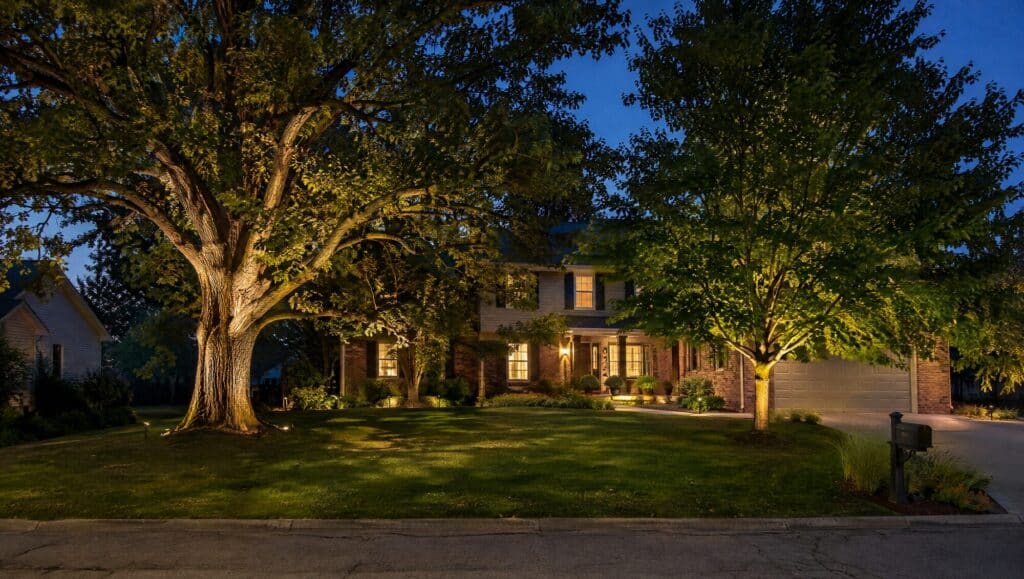
Not every tree deserves a spotlight. Picking the right ones, and the right technique for each, is most of the battle.
Trees are the backbone of most good landscape lighting designs. A well lit tree gives a yard height, depth and a sense of scale that low lights alone can't. On the west side, in Avon and the surrounding parts of Hendricks County, we see everything from big old oaks on established lots to young maples in newer subdivisions. Both can look great at night, but they call for different approaches.
The first question isn't how to light a tree. It's which trees to light. Lighting every tree in the yard usually looks busy and flat. A better approach is to pick two or three that do something for the property:
If a tree is scraggly, half dead or crowded by other trees, it probably isn't a good candidate. Light will show off its flaws just as clearly as a healthy tree's best features.
Uplighting means placing a fixture at the base of the tree and aiming it up into the canopy. It's the most common technique, and for good reason. It shows off the trunk and the underside of the branches and makes a tree look dramatic.
A few tips for uplighting:
Moonlighting flips the idea around. Fixtures are mounted high in the tree and aimed down through the branches, so light filters onto the lawn below in a soft, dappled pattern. It looks like moonlight coming through the leaves, which is where the name comes from.
Moonlighting works best on large, mature trees with an open canopy. It also lights up the ground around the tree, which makes it useful over patios, driveways and play areas. You can see more on our moonlighting and special effect lighting page, and we compare the techniques side by side in our uplighting, downlighting and moonlighting guide.
Two other techniques are worth knowing about. Silhouetting puts light on a wall or fence behind a tree or shrub so it shows up as a dark shape against a glowing background. It's great for plants with an interesting outline. Shadowing does the opposite, placing a light in front of a tree so its shadow is cast up onto the house. On a windy night, the shadows move. It's subtle and very pretty when it's done well.
A lot of Avon homes are in neighborhoods built in the last 10 or 20 years, and the trees are still growing. That's fine. For young trees, we use smaller fixtures and plan for them to be moved back and re-aimed as the tree grows. A good design for a young tree today shouldn't be a bad design in five years.
Indiana trees look very different in January than in July. Deciduous trees that look full and lush under light in summer show off their branch structure in winter, which can be just as beautiful. Evergreens give you consistency all year. A good mix gives your yard something to look at every season.
Fall is also when you'll notice light changes the most. As leaves come down, uplights that were hidden under foliage may suddenly look brighter. A quick re-aim or adjustment in late fall is normal.
Responsible tree lighting doesn't hurt the tree. Fixtures mounted in trees should be attached with hardware designed to let the tree grow, and wire should be run so it doesn't girdle branches. Ground fixtures should be placed to avoid damaging roots. It's one of the reasons we recommend having trees lit by someone who does it every day.
Lite Outdoor designs and installs landscape and outdoor lighting across the west side, including Avon, Plainfield and the rest of Hendricks County. See more on our Avon outdoor lighting page.
Request a free estimate or call 317-893-2590.


