
Menu
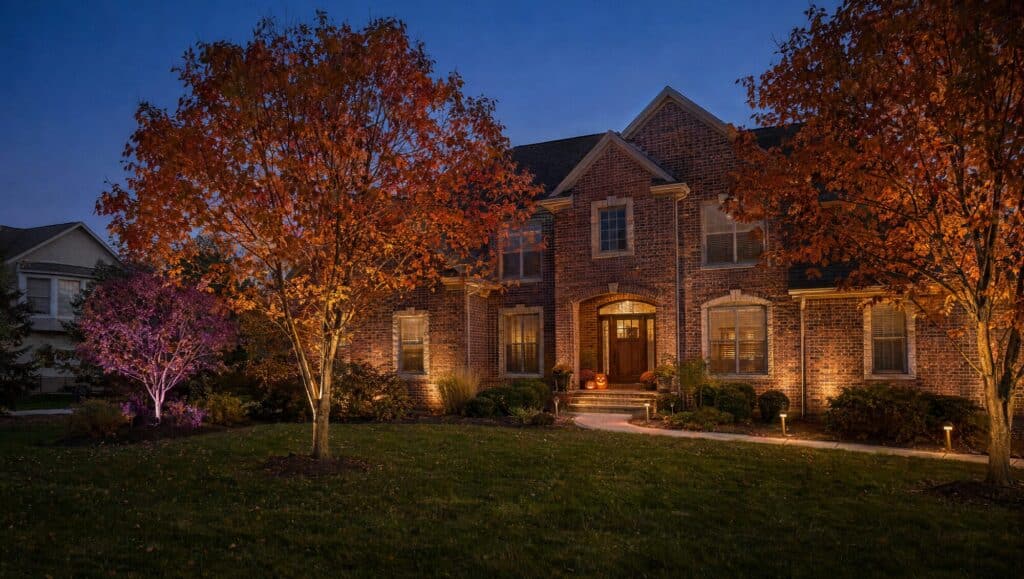
Orange in October, blue on Sundays, red and green in December. Color-changing landscape lighting can do all of it, as long as you don't overdo it.
Every October, the questions start coming in. "Can you make my house glow orange for Halloween?" "Can the trees be blue and white for Colts games?" "Can I do red and green for Christmas without getting up on a ladder?"
The answer to all three is yes. RGB color-changing landscape lighting has come a long way in the last few years, and it's one of the more fun upgrades you can add to an outdoor lighting system. Here's what you should know before you dive in.
RGB stands for red, green and blue. An RGB fixture has separate LEDs in each color, and by mixing them at different levels it can produce a huge range of colors. Better fixtures also include a dedicated white channel (often called RGBW), which matters more than you might think. More on that below.
The fixtures look just like regular landscape lights. They're controlled from an app on your phone, where you can pick colors, set up scenes and schedule changes.
Here's the part that surprises people. The best RGB systems spend most of the year in plain warm white. Your house should look like a well lit home 340 nights a year, not a nightclub.
That's why the white channel matters. Cheaper RGB fixtures try to make white by mixing red, green and blue, and the result is usually a slightly off, bluish or pinkish white. A fixture with a dedicated warm white LED looks just like a regular landscape light until you want color. Then you switch scenes and the house changes.
Here are a few ways Indianapolis homeowners use color:
The most common mistake with RGB is using too much of it. A whole house in saturated green doesn't look festive. It looks strange. Some guidelines we follow:
You don't need every fixture to change color. A common approach is to make the uplights on the front trees and a few facade lights RGB, and leave the path, step and driveway lights as standard warm white. That keeps the cost reasonable and gives you plenty of flexibility.
Some neighborhoods around Indianapolis have HOA guidelines about exterior lighting. Holiday displays are almost always fine, but if you plan to run color year-round, check your covenants first. It's also just good manners to keep color subtle and on a timer.
In many cases, we can add RGB fixtures to a system you already have. It depends on the transformer, the wiring and the controller. If your current system is older halogen, it usually makes sense to talk about an LED upgrade at the same time.
Lite Outdoor designs and installs RGB color-changing lighting across Greater Indianapolis, along with traditional architectural lighting and landscape lighting. If you'd like to see what color could do for your home, we're happy to show you.
Request a free estimate or call 317-893-2590.


