
Menu
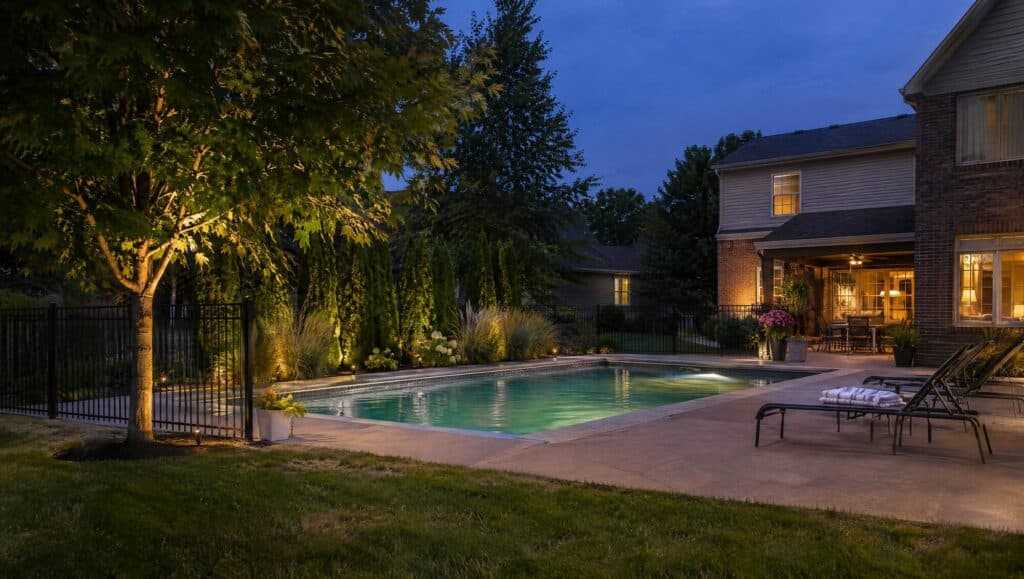
The last few weeks of summer are when backyard pools get the most use after dark. A little planning keeps the pool area safe and comfortable without turning it into a hotel pool deck.
In Noblesville, pool season is short but intense. Memorial Day to Labor Day, a backyard pool is the center of the house. Kids want to swim until bedtime. Adults want to sit by the water after the kids finally go in. And by late August, the sun is setting earlier every night, so the pool area spends more and more of its useful hours in the dark.
Most pools come with an underwater light or two, and that's a good start. But a pool lit only from inside the water can feel like a glowing rectangle in a black yard. The deck, the steps, the fence and the landscaping around it all disappear. That's where landscape lighting comes in.
Around a pool, the first job of lighting is to make every edge and change in level easy to see. That means:
None of this needs to be bright. Low, warm light at the right spots does more for safety than one floodlight on the back of the house, which mostly creates glare on wet surfaces and deep shadows everywhere else.
This is the part a lot of homeowners and even some installers don't know. Under the National Electrical Code, standard low-voltage landscape lighting can't be installed within 10 feet of the nearest edge of a pool, spa or fountain unless Article 680 specifically allows it. Many listed landscape fixtures even say so in their installation instructions.
In practice, that means the lighting right at the pool's edge needs to be planned carefully, using equipment rated for that location, while the rest of the pool area can be lit with a normal landscape system. A good designer works with that zone rather than ignoring it. Often the best results come from lighting things just outside the 10-foot line, like the landscaping, the fence and nearby trees, and letting that light spill gently toward the pool.
The plants and structures around a pool are what make it feel like a backyard instead of a public pool. Soft uplighting on ornamental grasses, a few trees or a privacy hedge creates a backdrop that frames the water. Reflections from those lights in the pool surface add a lot, too.
If you have a pergola, cabana or pool house nearby, light it like you would any other architecture: grazing light on the posts or stone, and downlights over seating areas.
Water acts like a mirror. A bare bulb anywhere near the pool will show up as a bright reflection, and it'll be in someone's eyes no matter where they sit. Use shielded fixtures, aim them away from the water and from seating, and keep the output modest. When you sit in a lounge chair, you should see lit surfaces, not light sources.
Most pool lights these days can change color, and that's fun for parties. For the landscape around the pool, though, we almost always stick with a warm white around 2700K. It looks natural on stone, wood and plants and it flatters people too. If you want color, our RGB color-changing lighting can be added to selected fixtures so you can switch between warm white for everyday and something more festive for a party.
You'll see your pool from the kitchen and family room far more often than you'll swim in it after dark, especially from October to May. A well lit pool area with some landscape lighting around it looks great through the window all year, even with a cover on.
Pool area lighting works best on its own zone. That way you can have the paths and steps on a timer every night for safety, and the accent lighting around the pool only when you're out there. A smart controller makes it easy to switch scenes from your phone.
Lite Outdoor designs and installs pond and pool area lighting throughout Noblesville and Hamilton County. We also handle the deck and patio lighting that usually goes with it. Learn more about our work on our Noblesville outdoor lighting page.
Request a free estimate or call 317-893-2590.


